05 JAN 2026
The Difference Between BLS and CPR Certification in Alabama: Which One Do You Need?
If you're exploring life-saving training options in Alabama, you've probably encountered two common terms: CPR certification and BLS certification. While both involve learning cardiopulmonary resuscitation techniques, they're designed for different audiences and serve distinct purposes. Understanding the difference between BLS and CPR certification is crucial for meeting your professional requirements, whether you work in healthcare, education, or another field where emergency response skills matter.
What is CPR Certification?
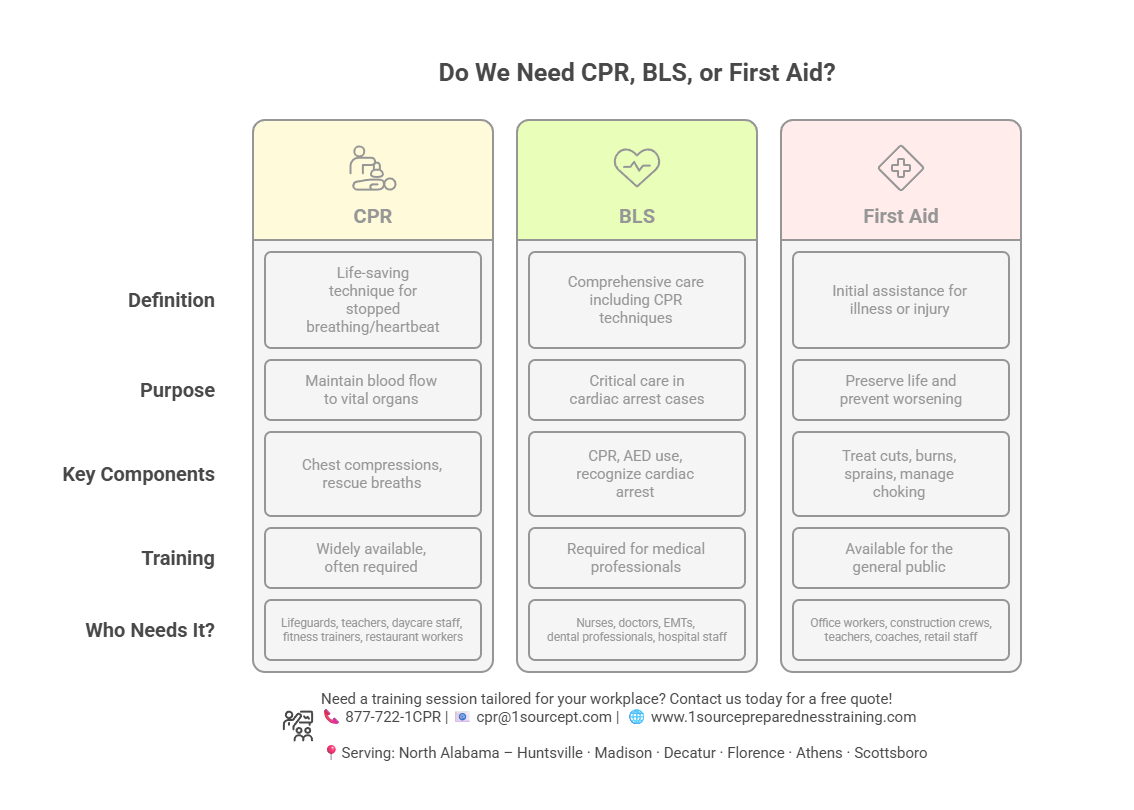
CPR (Cardiopulmonary Resuscitation) certification is designed for the general public and non-healthcare professionals who want to respond effectively during cardiac emergencies. CPR classes in Alabama teach participants how to perform chest compressions, deliver rescue breaths, and use an Automated External Defibrillator (AED) on adults, children, and infants.
Common CPR certification courses include Heartsaver CPR AED through the American Heart Association and similar programs offered by the American Red Cross and ASHI. These courses typically last 2-4 hours and focus on basic life-saving skills that anyone can learn and apply in everyday situations—at home, in public spaces, or at work.
CPR training is ideal for teachers, coaches, childcare providers, personal trainers, lifeguards, office workers, and concerned citizens who want to be prepared for emergencies. The curriculum emphasizes recognizing cardiac arrest, calling 911, performing high-quality chest compressions, and using an AED safely. Many Alabama employers require CPR certification for staff who interact with the public or work in environments where medical emergencies could occur.
What is BLS Certification?
BLS (Basic Life Support) certification is the professional-level CPR training required for healthcare providers and first responders. BLS courses in Alabama cover everything in standard CPR training but add advanced techniques and scenarios specifically designed for medical professionals working in clinical environments.
BLS certification goes deeper into the science of resuscitation, teaching healthcare providers how to work as part of a coordinated response team. The curriculum includes two-rescuer CPR scenarios, bag-valve-mask (BVM) ventilation, managing choking in responsive and unresponsive patients, and understanding the critical role of high-quality CPR in the chain of survival.
Medical professionals including nurses, doctors, paramedics, EMTs, dental hygienists, respiratory therapists, medical assistants, and anyone working in hospitals, clinics, nursing homes, or emergency medical services must maintain current BLS certification. Many Alabama healthcare employers verify BLS certification before hiring and require renewal every two years to maintain employment eligibility.
⤷ Key Differences Between CPR and BLS Certification
While both certifications teach life-saving skills, several important distinctions separate them. Understanding these differences helps Alabama professionals choose the right training for their needs.
- Target Audience: CPR certification targets the general public and non-medical professionals, while BLS certification is specifically designed for healthcare providers and first responders who will use these skills in professional medical settings.
- Course Depth and Complexity: CPR classes cover fundamental techniques at a level appropriate for laypersons. BLS courses dive deeper into resuscitation science, team dynamics, and advanced airway management. BLS students learn more detailed assessment skills and must demonstrate proficiency at a higher performance standard.
- Team-Based Scenarios: Standard CPR certification focuses on single-rescuer response, teaching individuals how to manage emergencies alone until professional help arrives. BLS certification emphasizes coordinated team response, training healthcare providers to work together efficiently during codes and emergency situations where multiple providers are present.
- Equipment and Techniques: CPR courses teach basic rescue breathing and may introduce barrier devices like pocket masks. BLS certification includes training on bag-valve-mask devices, oxygen delivery systems, and more sophisticated airway management techniques used in medical facilities.
- Assessment and Testing: While both certifications require skills demonstration, BLS testing is more rigorous and demanding. BLS students must perform skills with greater precision and demonstrate understanding of medical concepts that go beyond basic CPR knowledge.
- Course Length: CPR certification courses typically last 2-4 hours, making them accessible for busy schedules. BLS certification courses usually run 4-5 hours due to the additional content and more extensive hands-on practice required.
Who Needs BLS Certification in Alabama?
Alabama healthcare employers consistently require BLS certification for clinical positions. Nurses working in hospitals, outpatient clinics, surgical centers, and long-term care facilities must hold current BLS credentials. Medical assistants, phlebotomists, and patient care technicians typically need BLS certification even if their primary duties don't involve direct emergency response.
Dental professionals including dentists, dental hygienists, and dental assistants require BLS certification in most Alabama dental practices, particularly those that provide sedation services. Emergency medical services professionals—paramedics, EMTs, and emergency medical responders—must maintain BLS certification as a fundamental requirement of their licensure.
Physical therapists, occupational therapists, respiratory therapists, and other allied health professionals working in clinical settings generally need BLS certification. Even some pharmacy technicians and radiologic technologists may require BLS depending on their work environment and employer policies.
Healthcare students pursuing degrees in nursing, pre-med, dental hygiene, or other medical fields should obtain BLS certification early in their academic programs. Many Alabama nursing schools and healthcare programs require BLS certification before students begin clinical rotations.
Who Needs Standard CPR Certification in Alabama?
While BLS serves medical professionals, standard CPR certification meets the needs of many other Alabama workers and community members. Teachers and school staff benefit from CPR and first aid certification, with many Alabama school districts requiring or strongly encouraging this training for employees who supervise students.
Childcare providers and daycare workers often need CPR certification to meet Alabama childcare licensing requirements. Coaches, athletic trainers, and fitness professionals should maintain current CPR certification to respond to sports-related cardiac events. Lifeguards and aquatics staff require CPR certification as part of their employment qualifications.
Personal trainers, gym staff, and recreation center employees increasingly pursue CPR certification as a professional credential and safety measure. Construction supervisors, warehouse managers, and workplace safety coordinators may need CPR training to meet OSHA emergency preparedness standards or company safety policies.
Many Alabama residents pursue CPR certification for personal reasons—to protect family members, be prepared as parents or grandparents, or simply have the confidence to help during emergencies in their communities.
Can You Have Both Certifications?
Healthcare professionals who hold BLS certification don't need separate CPR certification because BLS training encompasses and exceeds standard CPR competencies. However, some Alabama professionals maintain both credentials if they work in multiple roles or settings with different requirements.
For example, a nurse who also coaches youth sports has BLS certification for hospital work but might obtain separate Heartsaver Pediatric First Aid CPR AED certification specifically focused on youth sports injuries and child-specific emergencies. Some professionals prefer having both certifications to demonstrate comprehensive emergency preparedness across different contexts.
Choosing the Right Certification for Your Needs
Determining whether you need BLS or CPR certification in Alabama depends primarily on your profession and employer requirements. If you work in healthcare or emergency medical services, BLS certification is almost certainly required. Check with your employer, licensing board, or academic program to confirm specific requirements.
If you work outside healthcare but want emergency response skills for personal preparedness or workplace safety, standard CPR certification provides the appropriate training level. Teachers, coaches, fitness professionals, and childcare providers typically need CPR rather than BLS certification unless their employer specifically requires the healthcare-level credential.
When researching training providers in Alabama, verify they offer American Heart Association, American Red Cross, or ASHI certification—the nationally recognized credentials most employers accept. Confirm the certification type matches your needs, and ask about course length, hands-on practice opportunities, and certification card issuance timelines.
Maintaining Your Certification
Both CPR and BLS certifications expire after two years, requiring renewal to maintain valid credentials. Alabama healthcare providers must plan ahead to renew BLS certification before expiration to avoid employment complications. Many hospitals and medical facilities offer on-site BLS renewal courses for staff convenience.
Renewal courses (often called "recertification" or "refresher" courses) are shorter than initial certification classes, typically lasting 2-3 hours. These courses review essential skills, update participants on any guideline changes, and verify continued competency through skills testing.
Ready to obtain the right certification for your Alabama career or personal preparedness goals? Whether you need professional-level BLS certification or standard CPR training, choosing a qualified provider with flexible scheduling and hands-on instruction ensures you gain the confidence and competence to save lives when seconds matter.
📧 info@1sourcept.com | 📞 877-722-1CPR (877-722-1277)
📍Serving:
North Alabama – Huntsville · Madison · Decatur · Florence · Athens · Scottsboro · Cullman · Oxford · Anniston
Northwest Indiana – Gary · Hammond · Merrillville · Crown Point · Valparaiso · Portage · Michigan City
Stay prepared. Stay safe. Stay trained.